
In the picture below, are Bibles and a worship book. The worship book (bottom) belonged to my great grandmother and dates back to 1873. Of the four Bibles, the top one belonged  to my grandfather, the next two to my father, and the fourth one down was mine. Naturally, there are stories that go with each of these Bibles, but the important point for this article is that they are symbols of the past, present and future. You see, the Bibles and the worship book were carried by men and women who were people of faith. The Bible that is the second from the bottom was given to me by my parents as a Christmas present when I was 12 (ok, 1958 so you don’t have to do the math). This Bible represents one of the ways that my parents delivered to me a heritage of faith. They put me in a position to make my faith my own by giving me a resource for use in church, yes, but their intent was that I would study God’s word for myself. As you can see by the worn cover, I took them up on the challenge to learn to apply God’s word to my own life. It was with this Bible that I developed my views on the church’s position on serving in the military during the season that I was being drafted for military service. It was with this Bible that I learned the intent of baptism and why I should be baptized. It was with this Bible that I engaged in numerous Bible drills, a competition to see who could find a particular passage first. I actually got pretty good at it because I knew my Bible and where the different books would be just by looking at the closed book. Most importantly, this Bible served me well as I built a platform for my faith and theology, those thoughts of God that determined how I would view life on this earth.
So what is the title all about? The title, “Faith – Heritage and Legacy” means that we learn about faith from our parents and grandparents. We have a choice whether to adopt their faith or become convinced of our own faith. But here is the key, (1) we all have a view of God (faith) whether it is right or wrong, and (2) we will all leave traces of our faith with family, friends, and others in our sphere of influence. Thus, we will all have a legacy which we will leave behind. I can hear some saying now, that their legacy will be completely neutral permitting others to conclude truth for themselves. Any of us who interact with other people (human beings) leave an imprint, a fingerprint that is uniquely ours. After each interaction, people decide (a) whether they like us or not, (b) whether they agree with us or not, (c) whether they care to see us again, or not, (d) and the list goes on and on.
The human mind is a fascinating thing and is able to make value judgements while interacting with another person. We all do it without even trying to be judgmental. We get down on people who are judgmental. We like people who make us laugh. We tend to like people who see society and matters of faith very much as we see them. Whether we want to admit it or not, we will leave an impression, a legacy, that encourages people to see things as we saw them or they may be so disenchanted by us that they will avoid adopting any similarities to us. Either way, it is a legacy. It should come as no surprise to you that my view of God (faith) played a significant role in my life, my work, and my interactions with family, friends, and business associates. I pray that my life has had a positive influence that invited others to examine their relationship with their Creator.
The book of Proverbs is filled with exhortations to a son to heed the instruction of his father and mother. Chapter 1:8 says, “Hear, my son, your father’s instruction and forsake not your mother’s teaching.” This theme is repeated over and over again. The Ten Commandments tell us to honor our father and mother so that our days may be long in the land that God is giving to us. Paul says to Timothy (2 Tim 1:5) “I have been reminded of your sincere faith, which first lived in your grandmother Lois and in your mother Eunice and, I am persuaded, now lives in you also.” The role of the parent and grandparent in encouraging the next generations in the faith is clear. So many of us have heard the testimony of Rachel Scott who was killed in the Columbine High School shootings in 1999. Still today, after being killed at age 17, her testimony is being told.
My friend, Crawford Loritts, pastor of Fellowship Bible Church in Roswell, GA, said in his book “Unshaken,” “Faith is both our heritage and our legacy.” We may have received a strong faith passed down from our parents, or we may have received a confusing set of theologically conflicting concepts. In the scriptures, Hebrews 11 gives us a list of people and how they expressed their faith. The scriptures are a resource to help you define and declare a true faith in God. The major point, however, is that we are and will be held responsible for that faith which we pass along to those who follow us. Think about how you build your reputation. Think about how you are known.
A distant relative recently passed and someone close attended the man’s funeral. As the event was being described to me today the comment was made that much was made about the man’s work accomplishments and his hobbies. While that is not bad, the next words of the story were troubling. They said, this was so different from this man’s dad’s funeral where his dad was described as a man who loved God and recollections were made of that man’s walk with the Lord. As for the man who was just buried, there was passing mention that he had placed his faith in Jesus Christ. The contrast between the two was striking. How will you be remembered? About what things were you most passionate?
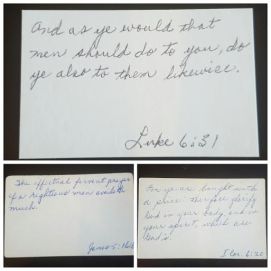 handwriting. The three verses were Luke 6:31, James 5:16 and 1 Corinthians 6:20. Obviously, the fact that these are in Mom’s handwriting brings back a lot of memories. Memories of her notes all around the house. I always admired the artistry of her handwriting. I thought is was delicately feminine and elegant at the same time. But beyond all that, the fact that she chose not to memorize from her Bible, and rather to sear these words in her mind by writing them first and then committing them to memory. This was a habit she continued until the day she went into the hospital where she transitioned into heaven two weeks later. As the years wore on, she took to memorizing chapters and then entire books of the Bible. She hid God’s word in her heart, she meditated on God’s wisdom day and night. When one of us would be feeling down, or acting up, she could draw from memory a verse that aptly applied to the situation on our minds or that would have the effect of easing the tension in our home.
 things like “Ever since I gave my life to Jesus, life has been wonderful!” Folks, the Bible tells us that we are aliens and strangers in this world (1 Peter 2:11). The ESV calls us sojourners and exiles. That same passage tells us we live in an evil world that wages war against our souls. In addition to the spiritual warfare that is going on in this world these days that includes things like abortions, men and women pursuing unnatural relations with one another, a society in which over half the country is on the government dole, and so on, we have the daily stuff of life. The need to work to provide for one’s family, the beautiful thing that is called marriage where two distinct individuals are to become one flesh, raising children in the way they should go and all that is entailed in these endeavors is enough to make some days feel pretty daunting.
 no doubt that in spite of my herky-jerky beginnings (think albatross, think gooney bird) that I was, in fact, completely and totally covered by the blood of Christ and my sins, past and future, were washed away. I had the behavior patterns of a young boy growing into his teen years with all that entails. But as I grew older, I was also growing in the knowledge of God. When I was 16, I attended a series of meetings (known in those days as Deeper Life evangelistic meetings) in Meade, Kansas. It was during those meetings that I was gripped with the need to make my faith my own. To own my faith meant to me that I needed to rely less on what my parents thought and more on what God would teach me through His word, the Bible.
 In my last post I commented that some of us grow up in a Christ-centered home and others grow up in homes that are almost the antithesis of that Christ-centered home. Those who actually go to the point of professing belief in the salvation that comes from Christ alone, however, set out on the same journey of faith. For some the embarkation on that journey is indiscernible and for others the transition is a marked transformation as the Holy Spirit begins to shape our minds to be more Christ-like. The degree of change seemingly has little to do with our upbringing. It has more to do with behavioral modification brought about by the work of the Holy Spirit in our hearts and minds.
 4th Quarter Musings